Wednesday, December 17, 2008
OKC Schools: no recycling program
Oklahoma City public schools don't have a standard recycling program, and only about half of the district's schools do any recycling at all. In my article in this week's Oklahoma Gazette, I met up with some high school students at Northwest Classen who started an environmental club called the Green Knights (here's their Web site). A faculty member drives the plastic bottles they collect to Edmond so they can be recycled--since the city doesn't have a system set up for them. Oklahoma City recycling trucks pass by the school every week, but the municipal recycling program only covers residences, not schools or businesses.
Here's a video interview with one of the students at Northwest Classen:
Monday, December 15, 2008
Inhofe and warming ... again
The Oklahoman put out an editorial today supporting U.S. Sen. Jim Inhofe's increasingly marginalized stance that climate change isn't the result of human emissions of heat-trapping gases.
Inhofe says 650 scientists support his theories, which go against the global scientific community and United Nations reports. As Grist points out, Inhofe has a history of reshaping the climate change debate by tricking the media into ignoring sound science:
The Oklahoman (which, for point of disclosure, is my former employer) ends its editorial with a question:Deniers like Inhofe have a serious media problem -- an ever growing number of studies, real-world observations, and credible scientific bodies all point to human-caused emissions as the increasingly dominant cause of planetary warming and dangerous climate change.
What's a denier to do? The answer is simple: Repackage previously debunked disinformation, release it as a "new" so-called "Full Senate Report" full of hysterical headlines, push it through right-wing news outlets, and hope the traditional media bites. Why not? It worked before.
With at least 58 Democratic senators, will Obama try to ratify the job-killing Kyoto global warming treaty?He might, which makes it good to know Jim Inhofe will be waiting and ready.
Wednesday, December 10, 2008
USATODAY: oklahoma schools with toxic environments
In case you missed it, USA Today had a big cover story yesterday on the presence of toxic and sometimes cancer-causing chemicals outside the nation's public schools.
The story has a useful online component. You can search by state or city or school to see if your kids or the kids in your neighborhood are being exposed to toxins in their schoolyards.
Several schools in Sand Springs, Okla., were high on the list. If you click on a school name, the site shows you which companies most likely contribute to the pollution.
In the case of Central Elementary School in Sand Spring, they include:
- Sheffield Steel Corp Sand Springs, Oklahoma
- Sinclair Tulsa Refining Co Tulsa, Oklahoma
- Nalco Co Tulsa, Oklahoma
- Webco Industries Inc Southwest Tube Div Sand Springs, Oklahoma
- Yuba Heat Transfer Tulsa, Oklahoma
Tuesday, December 2, 2008
Can you pick the state energy secretary out of a crowd?
Well, now you can. In this video interview, I ask Oklahoma Energy Secretary David Fleischaker about wind power, renewable portfolio standards, the nation's power grid and more. Filmed between sessions at the Oklahoma Wind Energy Conference. Here's his Wikipedia entry if you want more background.
TB Pickens, king of the metaphor ...
T. Boone Pickens addressed a crowd of Oklahoma reporters today wearing a charcoal suit and an orange tie. Handlers scurried about to keep him on schedule. Walking into the room he had a certain aura of importance about him.
Then he opened his mouth.
Instantly, the oil tycoon turned alt-energy advocate became just another guy.
"I don't have a handkerchief, so I'll need a napkin--or your tie," he said to one of his minions as they entered. Then, turning to reporters with a smile, he said, "With this wind blowing it really drives me crazy on allergies."
Nice intro to the topic of the day, and the topic of Pickens' year: wind energy. Pickens was scheduled to speak over lunch to a 1,000-person crowd at the Oklahoma Wind Energy Conference in Oklahoma City. (And, in case you've been asleep for six months, he's launched a major PR campaign to promote wind energy and natural gas).
Fielding reporters' questions before that engagement, Pickens slouched back on his heels, held the microphone limp on his chest and kept on hand in his pants pocket.
He took the questions with ease and invented metaphors along the way.
Asked by a television reporter what he thought plunging oil prices meant for wind power, Pickens said he had mixed feelings, "like if I saw my mother-in-law hauled off the edge of a mountain in a Cadillac."
He paused, then added: "I don't have a mother-in-law, so I can say that."
The reporters laughed.
Another asked how Pickens thought the country should deal with its shortage of compressed-natural-gas stations. Pickens channeled Kevin Costner:
"It'll happen over a period of time. The stations will come."
And then, channeling Randy Terrill, said:
"All I'm interested in is that it's American (fuel). Natural gas, battery, I only care if it's American."
(In case you're wondering, he drives a Honda Civic that runs on natural gas.)
Pickens said Oklahoma has more entrepreneurs per capita than any state in the nation. They will be able to figure out solutions to our nation's energy crisis, he said.
But, if the economy has anything to say about it, they may have to wait a bit on their investments. Pickens said he's having trouble getting credit for his wind farms in Texas. He delayed one project a year because of the credit crunch, he said.
He left reporters and investors with a word of advice for tough times: "Don't forget how to eat hamburgers."
Sure Oklahoma's windy, buuuut ...
If the nation enacts policies that support wind energy, Oklahoma is poised to be the No. 1 wind-power state in the country by 2030, a federal researcher said this morning at a conference in Oklahoma City.
Larry Flowers, of the National Renewable Energy Lab in Boulder, Co., said if the United States uses wind for 20 percent of its energy by 2030, Oklahoma is expected to see $44 billion in economic development and an increase of 19,000 rural jobs.
But that future is far from certain, he said.
“In the end, it’s policy and the politicians that are going to determine what does happen,” Flowers said.
The remarks came at the first Oklahoma Wind Energy Conference, which continues today and tomorrow morning at the Cox Convention Center in Bricktown.
The lack of power lines used to move wind energy from the Great Plains to power-hungry cities is a major obstacle to Oklahoma future with wind energy, Flowers said.
Oklahoma’s energy secretary, David Fleischaker, echoed that sentiment.
“The wind tends to blow in places where we don’t have the large population centers,” he said. “So we have the problem--the challenge--of building transmission lines out.”
In an interview, Fleischaker said Oklahoma has been seen as an ant-alternative energy state until recently.
It’s working to change that image with conferences like this one. In recent years, utility companies and ranchers are warming to the idea of wind power.
Nationally, the United States has lagged behind other countries in terms of wind power development. Wind accounts for only 2 percent of the nation’s energy usage. Spain, for example, creates 12 percent of its energy from wind.
Flowers acknowledged the fact that Oklahoma’s wind industry has come a long way in a short time.
In 2000, the state didn’t produce any wind power, he said. Now the state has installed wind turbines to create up to 680 megawatts of power.
Fleischaker said if Oklahoma used only 10 percent of the available wind energy, it would have twice the power it needs for itself.
“You’ve come a long way Oklahoma … but there’s a long and big and spectacular future for you if you choose to follow that path,” Flowers said.
Wednesday, November 19, 2008
Coburn threatens filibuster on "open spaces" issue
A number of state's have voted recently to increase money for open spaces, or land that's not eaten up by development. Environmentalists see a number of benefits to setting land aside--it lets biodiversity thrive, cleans groundwater and gives people a place to go outside of suburbia.
Opponents say open spaces are either a detriment to the economy or an example of the government taking too much control of how people use land.
In an editorial today, the New York Times, says the recent state votes amount to a rebuke of the Bush Administration's decision not to fully fund the Land and Water Conservation Fund, which manages open spaces.
Sen. Harry Reid had wanted to bring up the open-spaces issue for debate at the end of this congressional session. According to the Times, Tom Coburn, of Oklahoma, brought that move to a halt--at least until next session.
From the NYT editorial:
We had hoped that Congress would approve the legislation in the current lame-duck session. On Monday, the Senate majority leader, Harry Reid, withdrew it from the calendar after Senator Tom Coburn, an Oklahoma Republican, threatened to filibuster the bill. Mr. Coburn called it a waste of money and an unnecessary expansion of federal control over public lands.
Mr. Reid said the Senate needed to focus on the economic crisis, but he promised to bring the measure up for immediate action early next year.
Old business tends to get lost in the early days of a new Congress, especially when there is a new administration. Come January, we will remind Mr. Reid of his promise and of the voters’ clear commitment to preserving open spaces.
Monday, November 17, 2008
Olympic swimmer weighs in on oceans/Oklahoma
In an interview with MSNBC, Olympic gold medalist and ocean advocate Aaron Peirsol name-drops Oklahoma as he plugs the idea that all of the world's waters are connected. While the U.S. swimmer probably spends most of his time in a chlorinated pool, he's campaigning for all of us to do our part to protect the world's oceans--even if you live super-far from them.
Here's an excerpt from the interview:
Q: What needs to happen to clean them up? What can the average person do to help?A: I believe it's a matter of collective involvement. What I said about the little things making a big difference; I believe that to be very true. I’m a part of a program called Toyota’s Engines of Change Program. The message is that anyone can make a difference in their community or for whatever cause they feel strongly about. Everyone can be an Engine of Change.
For me, I work with Oceana to help save the oceans. But anyone can help. The canvas bags at the grocery market; the buying of sustainable fish at the market; and even the knowledge that every river does lead to an ocean. It really is the easy things that can add up to be a lot. They don't cost a lot of money, just a little time, and a willingness to make a change. It doesn't matter that you live in Oklahoma or Iowa; everyone has a profound effect on the ocean, and the environment in general. (emphasis added) Recycling seems easy enough, but here in Austin we only just received recycling bins large enough to take all of our recyclables. There is still a long way to go.
Bode named head of national wind group
Former Oklahoma Corporation Commissioner Denise Bode has been named chief executive officer of the American Wind Energy Association.
The Republican had stepped down from her spot on the corporation commission to head up the American Skies Foundation. She will leave that position to become head of the national wind-power group on Jan. 2.
In a former life, Bode served for seven years as the president of the Independent Petroleum Association of America.
Read more here.
Sunday, November 16, 2008
Chesapeake won't reveal "fracing" forumla
To get natural gas out of the ground, natural gas companies like Oklahoma City's Chesapeake Energy inject millions of gallons of water, sand and chemicals deep into the earth. This process, called hydraulic fracturing, or "fracing," dislodges natural gas so that the company can extract it and sell it to heat homes and make electricity.
The problem is that most natural gas companies won't say what they're injecting into the ground. An investigation by ProPublica, a non-profit journalism group, found that many of the chemicals used in fracing could contaminate groundwater. The federal government lists many as toxic, and in some instances the chemicals make the gas wells explosive. The EPA wrote a 2004 study saying the process is safe. But new criticisms of fracing are coming to the surface.
In its story, which you can read here, ProPublica finds that many natural gas companies won't reveal their recipes for these chemical and water injections. In most states, regulations don't require them to. Here's an excerpt from the story that concerns Chesapeake Energy's recipe:
The issue is becoming more important as natural gas is talked about as a solution to the country's energy needs. Natural gas is cleaner burning than coal, which is the United States' most abundant energy source. It's also second in availability. But it appears that its extraction may come with environmental costs you don't hear talked about quiiiite as much as the Pickens Plan."It is like Coke protecting its syrup formula for many of these service companies," said Scott Rotruck, vice president of corporate development at Chesapeake Energy, the nation’s largest gas driller, which has been asked by New York State regulators to disclose the chemicals it uses.
Oklahoma recycling pledges
By John Sutter
Recycle something and then get some more stuff for free (which you can recycle later, I suppose).
That's pretty much the idea behind the Oklahoma Recycling Association's annual recycling drive, which continues through Nov. 25.
Make a recycling pledge on their Web site. Choices include buying recycled-content products, recycling more often and volunteering with recycling groups. I might choose the "other" category. I need to get back to work on the compost bin. It's basically an unchanging heap of trash at the moment. Need to get those microbes in gear.
Those who enter have a chance to win one of several prizes, including an electric riding lawnmower and bicycles.
Friday, November 14, 2008
Water and climate change: a study comes to Oklahoma
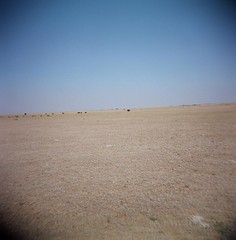
[photo: Western Oklahoma: where there's circa no water ... Sorry, I don't have a picture of Lake Altus...]
By John Sutter
As the world gets warmer, water resources are sure to get weirder. Wet areas are expected to get wetter, and dry areas are supposed to get drier as humans continue to release huge amounts of heat-trapping gases into the atmosphere.
Now, a state and federal agency want to find out what climate change will do to Oklahoma's already stretched water resources. The state Water Resources Board and a branch of the U.S. Department of Interior announced yesterday a $100,000 study looking at changes to water resources in two watersheds -- one in Oklahoma and one in Texas.
The Oklahoma side of the study will focus on an area that includes Lake Altus, which is a major source of water used for irrigating cotton crops in the southern part of the state. The study will look at water availability and also the resource's impact on local ecology.
The study comes at a turbulent time for water law in Oklahoma. The state is in the process of writing a new water policy which will govern how Oklahomans use water for the next 50 years. The results of the study, to be finished by 2010, will be incorporated into the new water plan, officials said in a news release.
If you're interested, here's a schedule of upcoming water plan meetings. The process--which includes a bunch of community-level meetings in all corners of the state--is expected to be finished by 2011.
IN NATIONAL water news, the New York Times' blog Dot Earth notes that the Center for Biological Diversity may soon sue to force the federal government to regulate carbon dioxide emissions under the Clean Water Act. Environmentalists are coming at carbon regulation from all angles--often trying to use existing environmental regulations, like the Clean Air Act and the Endangered Species Act, as reasons for the EPA to clamp down on emissions of heat-trapping gases. Using the Clean Water Act to this end would be new, though. The group may claim that the EPA must regulate carbon dioxide because it is making the oceans acidic, which is killing marine life.
In the blog, a White House spokesperson said such a move would create a "regulatory train wreck." The Bush Administration has opposed using existing environmental laws as reason to control carbon dioxide emissions.
Thursday, November 13, 2008
State to clean up (just of few) diesel buses
I wrote a story in last week's Oklahoma Gazette about Oklahoma's efforts to clean up some of its dirty diesel school buses. The exhaust from the buses exacerbates asthma and could cause cancer, yet most of Oklahoma City's buses follow old standards and none have been upgraded so that they're healthier for kids -- at least not yet.
Check out the full story here.
And here's a video of a state Department of Environmental Quality staffer explaining a new federal grant program that is expected to clean up some of the emissions, making some kids' lungs a little less sooty:
Grassy cellulose on NPR
By John Sutter
If you haven't heard that some plants other than corn can be made into biofuels, check out this NPR story on efforts in California to turn prairie grasses into ethanol.
Similar research is going on in Oklahoma, and the Tulsa World reports that the state recently received a $15 million grant to research how exactly scientists will go about getting switchgrass ready for car engines. There's already a 1,000-acre switchgrass plot in the Oklahoma Panhandle.
Environmentalists have pointed to a host of problems with corn ethanol, and that's made room for non-food crops to claim their spot as the "second generation" of the biofuels movement.
For evidence of this backlash, you need not look further than the SUV the state secretary of the environment drives for state business. GM donated the vehicle, which now is painted with nebulous planty designs (similar to the Hummer above, although that's not the actual vehicle). The old model was this wild yellow color and had corn all over it.
Monday, November 3, 2008
State question: hunting rights
I hadn't heard anything about State Question No. 742, which would amend the Oklahoma Constitution to list hunting and as fishing personal rights, until this morning, when I was listening to KGOU, the local NPR station.
The station pointed me to a voter's guide, by the League of Women Voters, which says animal rights groups oppose the amendment because it could limit the state's ability to preserve wildlife for uses other than food and sport. Proponents of the amendment fear animal rights people will try to strip them of their rights to hunt and fish.
Not that this sounds like a reliable source, but someone on at site called glocktalk.com, which has a big ole' gun as its banner, says the measure, if passed, would provide a "permanent Constitutional safeguard against anti hunting efforts in the state of Oklahoma."
Let me know if you all have any thoughts. If I learn more, I'll add to the post.
Here's the text of the question, which will be on the ballot tomorrow:
This measure adds a new section to the State Constitution. It adds Section 36 to Article 2. It gives all people of this state the right to hunt, trap, fish and take game and fish. Such activities would be subject to reasonable regulation. It allows the Wildlife Conservation Commission to approve methods and procedures for hunting, trapping, fishing and taking of game and fish. It allows for taking game and fish by traditional means. It makes hunting, fishing, and trapping the preferred means to manage certain game and fish. The new law will not affect existing laws relating to property rights.
Wednesday, October 29, 2008
Short-term data: Oklahoma City already warming
Climate change is a long-term phenomenon that plays out over many years. One cold winter, for instance, doesn't mean much if winters are getting milder and shorter over the course of decades. The changes also aren't expected to be uniform -- a few places may actually get cooler, but overall the climate will warm.
Those ideas play out in some government data crunched by a group called Environment America and recently released as a report called "Feeling the Heat."
Oklahoma City, like many other places, has warmed between 2001 to 2007. On average, temperatures during that period were 1.3 degrees Fahrenheit warmer than temps from 1971 to 2000. 2006 was the fourth hottest year in the city's history, according to the report, and that year was 2.2 degrees above the historical average.
Again, it's just a short-term look at a long-term trend. I still thought you all might find it interesting. Check out the report, and let me know what you think. Meanwhile, as temperatures drop this fall season, I'm sure we can expect some editorial cartoons in The Oklahoman poking fun at the idea of "global warming" when there's snow on the ground.
Tuesday, October 21, 2008
Videos: rumored Chesapeake buyout; green energy editorial
The Oklahoman has a couple of videos up today on the energy sector. In the first, the paper reports on a rumor that one of Oklahoma City's huge natural gas companies -- Chesapeake Energy -- will soon be bought out by investors. One of the company's officials reportedly denied a possible takeover. Chesapeake's stocks have been plummeting in tandem with natural gas prices. For a little background, Oklahoma is one of the top natural gas producers in the country, but only about a third of the gas produced here is actually used in-state.
Here's the video:
Here's another, an editorial in which Ed Kelley ponders the effect the national credit crunch will have on Oklahoma's alternative fuels industry. Wind power needs to be a priority in Oklahoma, he says, adding that the state could be the second or third biggest producer of wind power in the country within a decade if things go well. Still, for a little perspective, only 7 percent of energy used in the United States comes from renewable sources. And of that renewable piece of the pie, only 5 percent is wind power.
Oklahoma is one of the country's top energy users per capita. It ranks 11th for per person energy consumption, according to the Energy Information Administration, which is an independent branch of the U.S. Department of Energy. I'd be interested to hear any energy-saving tips you all might have.
Check out the editorial video below, and let me know what you think. I find it interesting that the editorial doesn't mention climate change, which, aside from the economic possibilities of green power and pollution issues associated with fossil fuels, is the big reason scientists and activists promote alternatives.
Monday, October 20, 2008
Tar Creek buyout to finish by Dec. 2009
[photo: pieces of scrap metal are still bent around trees in picher, okla. they're somber reminders of a deadly tornado that hit more than four months ago. a pile of toxic mine waste is shown in the background.]
By John Sutter
State officials say the federal buyout of residents in a toxic mining site in the northeast corner of Oklahoma should be finished by December 2009. Here's the newsok story on the latest updates at the Tar Creek Superfund site.
From the story:
Osborn said that with some luck and another inflow of funds, the portion of the voluntary buyout dealing with residents and businesses within the northeastern Oklahoma Superfund site remains on track to be completed in 12 to 14 months.
"The funding stream will determine how fast we are able to go," he said. "The EPA is committed to giving us the money; it's a matter of how they can make that happen."
The trust already has spent or is encumbered to spend about $35 million on the buyout. It has about $9 million in pending deals and expects to need $12 million to $14 million in additional funds to complete the process, said J.D. Strong, Oklahoma's secretary of the environment.
If you haven't heard about Tar Creek, I think it's important to get some background. The toxic site is centered on Picher, Okla., which once was the heart of a huge lead and zinc mining district. The mines are underground, and, in 2006, Sen. Jim Inhofe, R-Tulsa, passed a plan to start moving people out of the area, because a government study found many house and businesses to be at risk for sinking into the abandoned mining caves. Inhofe previously had opposed any buyout plans. The area has been on the U.S. Environmental Protection Agency's list of Superfund (toxic waste) sites since 1983. Huge mountains of gravel mine waste are piled up all around town, and kids in the area have tested for high levels of lead in their blood. In May, a tornado hit the town, leveling half of the buildings and killing six people.
For more background, see this recent story I wrote for The Oklahoman.