Showing posts with label climate change. Show all posts

Monday, December 15, 2008

Inhofe and warming ... again

By John Sutter

The Oklahoman put out an editorial today supporting U.S. Sen. Jim Inhofe's increasingly marginalized stance that climate change isn't the result of human emissions of heat-trapping gases.

Inhofe says 650 scientists support his theories, which go against the global scientific community and United Nations reports. As Grist points out, Inhofe has a history of reshaping the climate change debate by tricking the media into ignoring sound science:

Deniers like Inhofe have a serious media problem -- an ever growing number of studies, real-world observations, and credible scientific bodies all point to human-caused emissions as the increasingly dominant cause of planetary warming and dangerous climate change.

What's a denier to do? The answer is simple: Repackage previously debunked disinformation, release it as a "new" so-called "Full Senate Report" full of hysterical headlines, push it through right-wing news outlets, and hope the traditional media bites. Why not? It worked before.

The Oklahoman (which, for point of disclosure, is my former employer) ends its editorial with a question:
With at least 58 Democratic senators, will Obama try to ratify the job-killing Kyoto global warming treaty?

He might, which makes it good to know Jim Inhofe will be waiting and ready.

Wednesday, October 29, 2008

Short-term data: Oklahoma City already warming

By John Sutter

Climate change is a long-term phenomenon that plays out over many years. One cold winter, for instance, doesn't mean much if winters are getting milder and shorter over the course of decades. The changes also aren't expected to be uniform -- a few places may actually get cooler, but overall the climate will warm.

Those ideas play out in some government data crunched by a group called Environment America and recently released as a report called "Feeling the Heat."

Oklahoma City, like many other places, has warmed between 2001 to 2007. On average, temperatures during that period were 1.3 degrees Fahrenheit warmer than temps from 1971 to 2000. 2006 was the fourth hottest year in the city's history, according to the report, and that year was 2.2 degrees above the historical average.

Again, it's just a short-term look at a long-term trend. I still thought you all might find it interesting. Check out the report, and let me know what you think. Meanwhile, as temperatures drop this fall season, I'm sure we can expect some editorial cartoons in The Oklahoman poking fun at the idea of "global warming" when there's snow on the ground.

Wednesday, October 22, 2008

More on sunspots: response to a comment


[slide: before getting thrown by this slide, read the post below ... i'll explain.]

By John Sutter


I think my last post may have left some undue confusion about the role of sunspots in temperatures here on Earth.

The post got this comment from a user who identified himself or herself as "skeptic":
If you plot the average mean temperature variance by decade alongside the average mean sunspot activity, you'll clearly see a correlation. I've plotted this data going back to 1890 and was shocked at how the averages moved in tandem.
I very much appreciate the comment and the opportunity for clarification. While there is some weak correlation between the absence of sunspots -- how blank the sun looks -- and increased temperatures way over here on our planet, the scales of both phenomenons don't match up. The amount of increased energy coming to the Earth from a blanker-looking sun is not nearly powerful enough to account for the increased temperatures that are being observed and projected. Something else has to be at play. Based on physical properties of heat-trapping gases like carbon-dioxide, and the massive quantities at which we're spewing them into the sky, scientists say these industrial emissions are by far the main cause of climate change.

The changes due to a doubling CO2 in the atmosphere (which is what we're doing) causes temperatures to rise 27 times higher than sunspots could account for, according to George Kling, a professor at the University of Michigan.

So, it's definitely a confusing point, but one that makes sense when you think about it. Sunspots can affect global temperatures, but their impact isn't strong enough to account for climate change. Hope that clears it up some. Let me know if you all have further questions. Also, if you have any good articles on this subject, I'd be interested to read them. Feel free to post in the comments section.

Tuesday, October 21, 2008

The sun is neat, confusing


By John Sutter

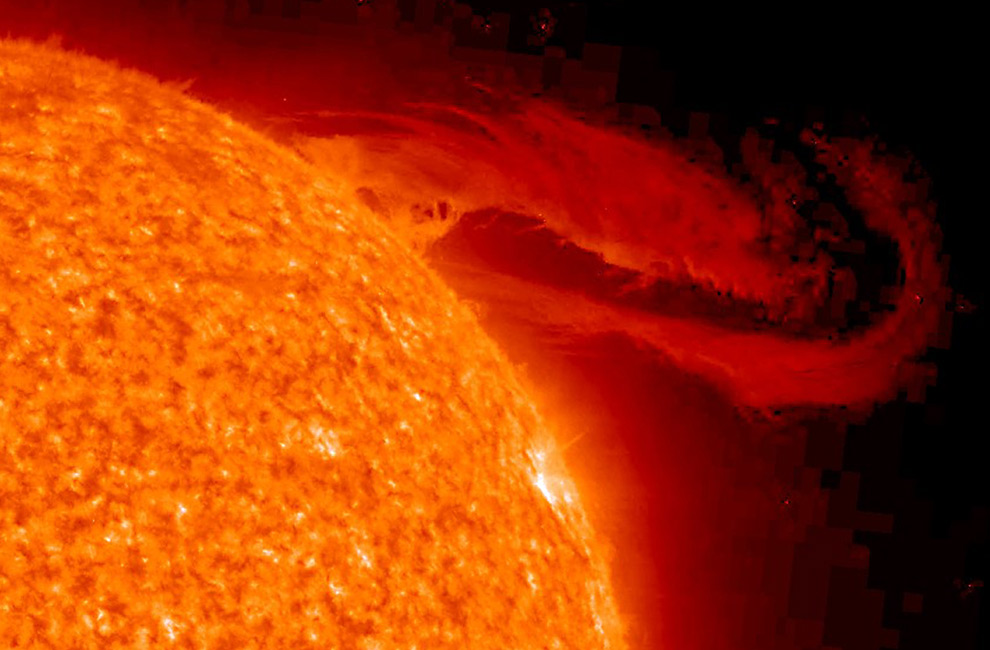
Check out these awesome pictures of the sun, from The Big Picture, on the Boston Globe's Web site. Pretty cool.

Of note is the fact that scientists don't know what the deal is sunspots lately. There appear to be fewer of them now than at any time since early in the 1900s. Some climate change skeptics have posited that the sun spots, instead of human emissions of heat-trapping gases, explain warming temperatures. Here's an NYT article about the uncertainty surrounding that claim. Another period of low solar activity coincided with global cooling and an Ice Age:
Scientists are not sure why this minimum has been especially minimal, and the episode is even playing into the global warming debate. Some wonder if this could be the start of an extended period of solar indolence that would more than offset the warming effect of human-made carbon dioxide emissions. From the middle of the 17th century to the early 18th, a period known as the Maunder Minimum, sunspots were extremely rare, and the reduced activity coincided with lower temperatures in what is known as the Little Ice Age.
A University of Michigan scientist I spoke with last week said that linking climate change to sunspots is misleading and irresponsible because the scale of the effects are so different and because sunspot patterns vary wildly over short periods of time. It's clear that heat-trapping gases emitted by our industries are to blame for climate change, he said.

Wednesday, October 15, 2008

Practice phenology: more interesting than it sounds, and no one else in OK is ...


[photo: leaves start to change their colors this time of year as the green pigment chlorophyll stops working in the transfer of sunlight into food. other colors start to show through. have you noticed if leaves in your backyard are changing? scientists want to know. you can help them out at the project budburst web site.]

By John Sutter


Helping scientists figure out climate change could be as simple as walking out your back door and writing down whether or not the leaves you see are green.

That was the pitch this morning from Kirsten de Beurs, an assistant professor of geography at Virginia Tech who spoke at an environmental journalists' conference in Roanoke, Va. De Beurs is one of a host of scientists pairing images from satellites with observations from volunteers on the ground to try to see how the planet is changing.

De Beurs said Americans have been slow to enlist themselves as citizen phenologists, which is just a phrightening code word for someone who studies seasons and other periodic changes in nature.

"It's not that hard to collect phenological data. Anyone can go outside, look at their backyard, tell what is green and enter that in a database," she said, "Then, you're a citizen scientist."

Oklahoma and North Dakota as the only two states from which people haven't contributed to a national network of basic environmental observations. By posting to the site, people not only help out scientists who don't have the funding to make all the observations themselves -- they also gain a basic and needed understanding of the world, de Beurs said.

Some satellite images show that vegetation zones in North America are moving north as the climate warms. There's been some controversy over the U.S. Department of Agriculture's vegetation map, which hasn't been updated since 1990 and may not reflect changes in the climate as more heat-trapping gasses become part of the atmosphere. The Arbor Day Foundation made a new map in 2006 that shows a shift in the growing zones that are commonly listed on the backs of seed packets (go here for an animation of the two maps.)

Here's more on that from USA Today:
The map doesn't show, for example, that the Southern magnolia, once limited largely to growing zones ranging from Florida to Virginia, now can thrive as far north as Pennsylvania. Or that kiwis, long hardy only as far north as Oklahoma, now might give fruit in St. Louis.
When looking at such changes, it's important to take many factors into consideration, de Beurs said. For instance, changes to agricultural land could be the result of government policies or economic conditions, not just changes in weather or climate. More satellite images are needed to draw some long term conclusions, she said, adding that there's no better way to strengthen the data than to contribute to it. Europe has had a hearty group of citizen scientists trolling for observations since the 1700s, she said. In the United States, it may be catching on just now.

Let me know by commenting on this page if you all decide to help out with Project BudBurst. The site has some information on plant identification and instructions with out to enter your observations so that scientists can use them. I'll e-mail de Beurs and let her know that she can cross another state of her list if any Oklahomans decide to contribute. You also might check out Oklahoma's Blue Thumb program, which lets volunteers supply state government with water quality samples. About 300 people who work with the program have become watchdogs for the streams and rivers they live near and care about.

Proponents of Blue Thumb say it's important since most of the state's rivers aren't monitored. There are some concerns that citizen-collected data isn't as reliable as data collected by trained scientists, but de Beurs told me that the observations are genuinely useful for researchers.

Monday, October 13, 2008

Parts of Oklahoma "abandoned" because of climate change

By John Sutter

A British research group released a report this week saying that parts of Oklahoma, Austrailia and rural China will be abandoned later this century because of water shortages associated with climate change.

The report, by Forum for the Future, lists Oklahoma as one of three places in the world where some land has been "more or less abandoned" because of the water shorages. It says people are moving to cities, where governments adapt to the situation using "novel infrastructure innovations" that provide water.

I found the story on the site for the Telegraph, a British newspaper. I'm not sure which parts of the state they're talking about, but I do know that the Oklahoma Panhandle experienced one of the worst droughts in its modern history this spring. Some farmers there told me conditions were more severe than in the 1930s Dust Bowl. Of course, the Dust Bowl covered a much larger area of the Great Plains, and lasted for a longer period of time. (See my former blog for a podcast with a 95-year-old farmer who was harvesting his wheat during the drought.)

Climate scientists in Oklahoma have said climate change likely will make droughts here longer and more severe. While they can make predictions like that in the long term, it's pretty much impossible to say that a specific drought -- like this one this year -- is directly tied to the warming climate.

Studies have shown that farmers in western Oklahoma are drawing down the Ogallala Aquifer by using deep wells to irrigate their crops. The wells keep getting deeper, and at these rates it's beleived that the groundwater source could run dry sometime this century.

A scientist speaking at a conference here in Virginia today (I'm writing this on a break) said that water is one of the more uncertain pieces of climate change models. Scientists are more certain about predicting future temperatures, but then they have to figure out how water bodies will react.