Wednesday, December 17, 2008
OKC Schools: no recycling program
Oklahoma City public schools don't have a standard recycling program, and only about half of the district's schools do any recycling at all. In my article in this week's Oklahoma Gazette, I met up with some high school students at Northwest Classen who started an environmental club called the Green Knights (here's their Web site). A faculty member drives the plastic bottles they collect to Edmond so they can be recycled--since the city doesn't have a system set up for them. Oklahoma City recycling trucks pass by the school every week, but the municipal recycling program only covers residences, not schools or businesses.
Here's a video interview with one of the students at Northwest Classen:
Monday, December 15, 2008
Inhofe and warming ... again
The Oklahoman put out an editorial today supporting U.S. Sen. Jim Inhofe's increasingly marginalized stance that climate change isn't the result of human emissions of heat-trapping gases.
Inhofe says 650 scientists support his theories, which go against the global scientific community and United Nations reports. As Grist points out, Inhofe has a history of reshaping the climate change debate by tricking the media into ignoring sound science:
The Oklahoman (which, for point of disclosure, is my former employer) ends its editorial with a question:Deniers like Inhofe have a serious media problem -- an ever growing number of studies, real-world observations, and credible scientific bodies all point to human-caused emissions as the increasingly dominant cause of planetary warming and dangerous climate change.
What's a denier to do? The answer is simple: Repackage previously debunked disinformation, release it as a "new" so-called "Full Senate Report" full of hysterical headlines, push it through right-wing news outlets, and hope the traditional media bites. Why not? It worked before.
With at least 58 Democratic senators, will Obama try to ratify the job-killing Kyoto global warming treaty?He might, which makes it good to know Jim Inhofe will be waiting and ready.
Wednesday, December 10, 2008
USATODAY: oklahoma schools with toxic environments
In case you missed it, USA Today had a big cover story yesterday on the presence of toxic and sometimes cancer-causing chemicals outside the nation's public schools.
The story has a useful online component. You can search by state or city or school to see if your kids or the kids in your neighborhood are being exposed to toxins in their schoolyards.
Several schools in Sand Springs, Okla., were high on the list. If you click on a school name, the site shows you which companies most likely contribute to the pollution.
In the case of Central Elementary School in Sand Spring, they include:
- Sheffield Steel Corp Sand Springs, Oklahoma
- Sinclair Tulsa Refining Co Tulsa, Oklahoma
- Nalco Co Tulsa, Oklahoma
- Webco Industries Inc Southwest Tube Div Sand Springs, Oklahoma
- Yuba Heat Transfer Tulsa, Oklahoma
Wednesday, December 3, 2008
Video iview: President of The Nature Conservancy
By John Sutter
I interviewed Mark Tercek, president and CEO of The Nature Conservancy, the largest conservation organization in the world, at the Oklahoma Wind Energy Conference today.
Tercek took his spot at the head of the organization earlier this year after spending more than 20 years at one of the world's largest investment firms, Goldman Sachs. There, he headed up an environmental investment team.
In this video interview, I ask Tercek what the credit crunch means for conservation and investment in renewable energy. He took a surprisingly positive view, saying these tough times are an opportunity for companies to reinvent themselves to become more environmentally friendly. He also saw a parallel between how the country got into this recession and how we got into so many environmental crises: we failed to look ahead.
Let me know what you all think.
Tuesday, December 2, 2008
Can you pick the state energy secretary out of a crowd?
Well, now you can. In this video interview, I ask Oklahoma Energy Secretary David Fleischaker about wind power, renewable portfolio standards, the nation's power grid and more. Filmed between sessions at the Oklahoma Wind Energy Conference. Here's his Wikipedia entry if you want more background.
Wednesday, November 19, 2008
Coburn threatens filibuster on "open spaces" issue
A number of state's have voted recently to increase money for open spaces, or land that's not eaten up by development. Environmentalists see a number of benefits to setting land aside--it lets biodiversity thrive, cleans groundwater and gives people a place to go outside of suburbia.
Opponents say open spaces are either a detriment to the economy or an example of the government taking too much control of how people use land.
In an editorial today, the New York Times, says the recent state votes amount to a rebuke of the Bush Administration's decision not to fully fund the Land and Water Conservation Fund, which manages open spaces.
Sen. Harry Reid had wanted to bring up the open-spaces issue for debate at the end of this congressional session. According to the Times, Tom Coburn, of Oklahoma, brought that move to a halt--at least until next session.
From the NYT editorial:
We had hoped that Congress would approve the legislation in the current lame-duck session. On Monday, the Senate majority leader, Harry Reid, withdrew it from the calendar after Senator Tom Coburn, an Oklahoma Republican, threatened to filibuster the bill. Mr. Coburn called it a waste of money and an unnecessary expansion of federal control over public lands.
Mr. Reid said the Senate needed to focus on the economic crisis, but he promised to bring the measure up for immediate action early next year.
Old business tends to get lost in the early days of a new Congress, especially when there is a new administration. Come January, we will remind Mr. Reid of his promise and of the voters’ clear commitment to preserving open spaces.
Monday, November 17, 2008
Olympic swimmer weighs in on oceans/Oklahoma
In an interview with MSNBC, Olympic gold medalist and ocean advocate Aaron Peirsol name-drops Oklahoma as he plugs the idea that all of the world's waters are connected. While the U.S. swimmer probably spends most of his time in a chlorinated pool, he's campaigning for all of us to do our part to protect the world's oceans--even if you live super-far from them.
Here's an excerpt from the interview:
Q: What needs to happen to clean them up? What can the average person do to help?A: I believe it's a matter of collective involvement. What I said about the little things making a big difference; I believe that to be very true. I’m a part of a program called Toyota’s Engines of Change Program. The message is that anyone can make a difference in their community or for whatever cause they feel strongly about. Everyone can be an Engine of Change.
For me, I work with Oceana to help save the oceans. But anyone can help. The canvas bags at the grocery market; the buying of sustainable fish at the market; and even the knowledge that every river does lead to an ocean. It really is the easy things that can add up to be a lot. They don't cost a lot of money, just a little time, and a willingness to make a change. It doesn't matter that you live in Oklahoma or Iowa; everyone has a profound effect on the ocean, and the environment in general. (emphasis added) Recycling seems easy enough, but here in Austin we only just received recycling bins large enough to take all of our recyclables. There is still a long way to go.
Friday, November 14, 2008
Water and climate change: a study comes to Oklahoma
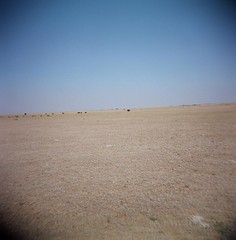
[photo: Western Oklahoma: where there's circa no water ... Sorry, I don't have a picture of Lake Altus...]
By John Sutter
As the world gets warmer, water resources are sure to get weirder. Wet areas are expected to get wetter, and dry areas are supposed to get drier as humans continue to release huge amounts of heat-trapping gases into the atmosphere.
Now, a state and federal agency want to find out what climate change will do to Oklahoma's already stretched water resources. The state Water Resources Board and a branch of the U.S. Department of Interior announced yesterday a $100,000 study looking at changes to water resources in two watersheds -- one in Oklahoma and one in Texas.
The Oklahoma side of the study will focus on an area that includes Lake Altus, which is a major source of water used for irrigating cotton crops in the southern part of the state. The study will look at water availability and also the resource's impact on local ecology.
The study comes at a turbulent time for water law in Oklahoma. The state is in the process of writing a new water policy which will govern how Oklahomans use water for the next 50 years. The results of the study, to be finished by 2010, will be incorporated into the new water plan, officials said in a news release.
If you're interested, here's a schedule of upcoming water plan meetings. The process--which includes a bunch of community-level meetings in all corners of the state--is expected to be finished by 2011.
IN NATIONAL water news, the New York Times' blog Dot Earth notes that the Center for Biological Diversity may soon sue to force the federal government to regulate carbon dioxide emissions under the Clean Water Act. Environmentalists are coming at carbon regulation from all angles--often trying to use existing environmental regulations, like the Clean Air Act and the Endangered Species Act, as reasons for the EPA to clamp down on emissions of heat-trapping gases. Using the Clean Water Act to this end would be new, though. The group may claim that the EPA must regulate carbon dioxide because it is making the oceans acidic, which is killing marine life.
In the blog, a White House spokesperson said such a move would create a "regulatory train wreck." The Bush Administration has opposed using existing environmental laws as reason to control carbon dioxide emissions.
Wednesday, October 29, 2008
Short-term data: Oklahoma City already warming
Climate change is a long-term phenomenon that plays out over many years. One cold winter, for instance, doesn't mean much if winters are getting milder and shorter over the course of decades. The changes also aren't expected to be uniform -- a few places may actually get cooler, but overall the climate will warm.
Those ideas play out in some government data crunched by a group called Environment America and recently released as a report called "Feeling the Heat."
Oklahoma City, like many other places, has warmed between 2001 to 2007. On average, temperatures during that period were 1.3 degrees Fahrenheit warmer than temps from 1971 to 2000. 2006 was the fourth hottest year in the city's history, according to the report, and that year was 2.2 degrees above the historical average.
Again, it's just a short-term look at a long-term trend. I still thought you all might find it interesting. Check out the report, and let me know what you think. Meanwhile, as temperatures drop this fall season, I'm sure we can expect some editorial cartoons in The Oklahoman poking fun at the idea of "global warming" when there's snow on the ground.
Tuesday, October 21, 2008
Videos: rumored Chesapeake buyout; green energy editorial
The Oklahoman has a couple of videos up today on the energy sector. In the first, the paper reports on a rumor that one of Oklahoma City's huge natural gas companies -- Chesapeake Energy -- will soon be bought out by investors. One of the company's officials reportedly denied a possible takeover. Chesapeake's stocks have been plummeting in tandem with natural gas prices. For a little background, Oklahoma is one of the top natural gas producers in the country, but only about a third of the gas produced here is actually used in-state.
Here's the video:
Here's another, an editorial in which Ed Kelley ponders the effect the national credit crunch will have on Oklahoma's alternative fuels industry. Wind power needs to be a priority in Oklahoma, he says, adding that the state could be the second or third biggest producer of wind power in the country within a decade if things go well. Still, for a little perspective, only 7 percent of energy used in the United States comes from renewable sources. And of that renewable piece of the pie, only 5 percent is wind power.
Oklahoma is one of the country's top energy users per capita. It ranks 11th for per person energy consumption, according to the Energy Information Administration, which is an independent branch of the U.S. Department of Energy. I'd be interested to hear any energy-saving tips you all might have.
Check out the editorial video below, and let me know what you think. I find it interesting that the editorial doesn't mention climate change, which, aside from the economic possibilities of green power and pollution issues associated with fossil fuels, is the big reason scientists and activists promote alternatives.
Monday, October 20, 2008
Tar Creek buyout to finish by Dec. 2009
[photo: pieces of scrap metal are still bent around trees in picher, okla. they're somber reminders of a deadly tornado that hit more than four months ago. a pile of toxic mine waste is shown in the background.]
By John Sutter
State officials say the federal buyout of residents in a toxic mining site in the northeast corner of Oklahoma should be finished by December 2009. Here's the newsok story on the latest updates at the Tar Creek Superfund site.
From the story:
Osborn said that with some luck and another inflow of funds, the portion of the voluntary buyout dealing with residents and businesses within the northeastern Oklahoma Superfund site remains on track to be completed in 12 to 14 months.
"The funding stream will determine how fast we are able to go," he said. "The EPA is committed to giving us the money; it's a matter of how they can make that happen."
The trust already has spent or is encumbered to spend about $35 million on the buyout. It has about $9 million in pending deals and expects to need $12 million to $14 million in additional funds to complete the process, said J.D. Strong, Oklahoma's secretary of the environment.
If you haven't heard about Tar Creek, I think it's important to get some background. The toxic site is centered on Picher, Okla., which once was the heart of a huge lead and zinc mining district. The mines are underground, and, in 2006, Sen. Jim Inhofe, R-Tulsa, passed a plan to start moving people out of the area, because a government study found many house and businesses to be at risk for sinking into the abandoned mining caves. Inhofe previously had opposed any buyout plans. The area has been on the U.S. Environmental Protection Agency's list of Superfund (toxic waste) sites since 1983. Huge mountains of gravel mine waste are piled up all around town, and kids in the area have tested for high levels of lead in their blood. In May, a tornado hit the town, leveling half of the buildings and killing six people.
For more background, see this recent story I wrote for The Oklahoman.
Thursday, October 16, 2008
Cattleman on a kayak
[Video: How often to you get to interview a cattle rancher from a river kayak? Check out this clip with Robert Curd, a cattleman in Virginia who raises about 80 cattle on 300 acres. He's using state and county money to keep his cattle -- and their problem-causing poop -- out of the James River.]
By John Sutter
Standing on a bank of the James River with other members of the Society of Environmental Journalists, colorful leaves seemed to hang in the air before wandering into the water. David Sligh, the water keeper for this part of the river, told our group of canoeists and kayakers that the river we were about to journey onto represented far more than this picturesque scene. It's a machine, he said, and one made up of many parts. Small streams and creeks that cover a quarter of the land in Virginia feed these waters. In turn, the James dumps its contents off of the eastern shore of the United States, into the Chesapeake Bay. But this natural machine is about more than just water, Sligh urged. Trees that line its banks filter out pollution. Oysters, once prevalent on the riverbed and now conspicuously absent, act as filters, too. And the farmers and factories and coal trains and mines and cities and people that exist in the James' watershed are inextricable constituents of the quality of this water.
This full-circle view of nature seemed to me to be the main point of our group's four-hour trip down the river, from a drop-off point at a bridge in Buchanan, Va. (pronounced here: "Buck-An-An.") Along our way, we heard from several of the river's stakeholders. Each gave our group a window into the sources of water pollution that plague this river and so many others across the country.
After weaving through some small rapids with a canoe partner who had a much better sense of how not to crash than I, our boats pulled into a shady spot to hear from Amanda Gray, a water planning engineer with the Virginia Department of Environmental Quality. Gray made many points, but perhaps the most useful was the fact that many of Virginia's waters (and many nationally, including most of those in Oklahoma) are not tested to see if they meet federal and state water quality standards. "The more we know, the worse it is," she said.
All states are required to submit reports on waters that are known to violate laws because their waters are impaired for some reason or another. Virginia, again, like many states, has a major backlog on those reports. Parts of the James River are listed as impaired, mostly because of E. coli and other bacteria, Gray said. The bacteria can make people who swim in the river sick. If a river meets water quality standards, the state government still expects about eight in 1,000 people who swim in it to become ill, she said, usually with a stomach ache or other digestion problems.
After some smooth paddling to a gravel bar, our next speaker, Anne Marie Clarke, of the Robert E. Lee Soil & Water Conservation District, told us about the sources of these and other pollutants on the James River. Leaky and outdated sewer systems and wild animals are much of the problem, she said, but cattle that graze on land in the watershed contribute as well. She pointed to county- and state-level programs that will pay cattle ranchers to essentially keep their animals from pooping in the river, or in places where it will get into the river. They're also paid to plant new trees along the banks of the water to stop erosion and so that fecal matter is filtered out before it hits the James. Nitrogen and phosphorus from the feces promote unhealthy levels of algae growth in the river, and that leads to ecosystem and water quality problems that can be felt all the way to the Chesapeake Bay.
Robert Curd, a cattleman, was up next. He has built fences along streams on his property and is trying to bring back forest. These measures improve his bottom line, he said, and make the soil, water and cattle healthier.
He urged government support for such measures, which, in his case, are fully subsidized. Without protection, farm land could go to development, which may pose greater threats to the environment, he said.
"We need to protect agriculture," he said. "You can do your best bang for your buck with agriculture, and get the best benefit in the water quality in the bay."
As we continued our paddle, I noticed how quiet and still -- seemingly natural -- parts of the river were, and how loud and industrial the atmosphere felt in other places. At one point, train tracks ran along both banks, and large engines carrying coal from the Appalachian Mountains clanged by, completely drowning out the lull of the rapids and the falling leaves. We stopped a few times, for lunch and a talk on sewer systems before coming to a final bank where we heard from Arthur Butt, a kayaker with a beard, a surfing history and a job at the Virginia DEQ.
Butt connected all of the dots for our group. He told us wow-factor stories about a time when these waters were full of oysters as big as his sandals, when the trees were much taller and older and when there were fish as big as our canoes. He again hit the point that everything here is connected -- so a farmer's methods in the mountains can have dire impacts on a fisher or crab trapper in the bay. The world's fisheries are under siege, he said, and it's "because we're putting so much pressure on them." The sea grasses that used to provide homes for crabs are gone from the river bottom, and oyster populations are 1 percent of what they would be if the river were healthy, he said.
For more on the James River, check out this video, where Butt explains where the water pollution comes from:
Wednesday, October 15, 2008
Practice phenology: more interesting than it sounds, and no one else in OK is ...
[photo: leaves start to change their colors this time of year as the green pigment chlorophyll stops working in the transfer of sunlight into food. other colors start to show through. have you noticed if leaves in your backyard are changing? scientists want to know. you can help them out at the project budburst web site.]
By John Sutter
Helping scientists figure out climate change could be as simple as walking out your back door and writing down whether or not the leaves you see are green.
That was the pitch this morning from Kirsten de Beurs, an assistant professor of geography at Virginia Tech who spoke at an environmental journalists' conference in Roanoke, Va. De Beurs is one of a host of scientists pairing images from satellites with observations from volunteers on the ground to try to see how the planet is changing.
De Beurs said Americans have been slow to enlist themselves as citizen phenologists, which is just a phrightening code word for someone who studies seasons and other periodic changes in nature.
"It's not that hard to collect phenological data. Anyone can go outside, look at their backyard, tell what is green and enter that in a database," she said, "Then, you're a citizen scientist."
Oklahoma and North Dakota as the only two states from which people haven't contributed to a national network of basic environmental observations. By posting to the site, people not only help out scientists who don't have the funding to make all the observations themselves -- they also gain a basic and needed understanding of the world, de Beurs said.
Some satellite images show that vegetation zones in North America are moving north as the climate warms. There's been some controversy over the U.S. Department of Agriculture's vegetation map, which hasn't been updated since 1990 and may not reflect changes in the climate as more heat-trapping gasses become part of the atmosphere. The Arbor Day Foundation made a new map in 2006 that shows a shift in the growing zones that are commonly listed on the backs of seed packets (go here for an animation of the two maps.)
Here's more on that from USA Today:
The map doesn't show, for example, that the Southern magnolia, once limited largely to growing zones ranging from Florida to Virginia, now can thrive as far north as Pennsylvania. Or that kiwis, long hardy only as far north as Oklahoma, now might give fruit in St. Louis.When looking at such changes, it's important to take many factors into consideration, de Beurs said. For instance, changes to agricultural land could be the result of government policies or economic conditions, not just changes in weather or climate. More satellite images are needed to draw some long term conclusions, she said, adding that there's no better way to strengthen the data than to contribute to it. Europe has had a hearty group of citizen scientists trolling for observations since the 1700s, she said. In the United States, it may be catching on just now.
Let me know by commenting on this page if you all decide to help out with Project BudBurst. The site has some information on plant identification and instructions with out to enter your observations so that scientists can use them. I'll e-mail de Beurs and let her know that she can cross another state of her list if any Oklahomans decide to contribute. You also might check out Oklahoma's Blue Thumb program, which lets volunteers supply state government with water quality samples. About 300 people who work with the program have become watchdogs for the streams and rivers they live near and care about.
Proponents of Blue Thumb say it's important since most of the state's rivers aren't monitored. There are some concerns that citizen-collected data isn't as reliable as data collected by trained scientists, but de Beurs told me that the observations are genuinely useful for researchers.
Land use: do we need new highways?
I was struck by the degree to which environmental issues overlap and feed into each other at a panel of environmental journalists and activists I attended last night in Roanoke, Va.
Cat McCue, from the Southern Environmental Law Center, made the interesting and often-overlooked connection between paved surfaces and water quality. According to government studies, she said, a paved city block creates nine times the runoff the same area would if it were covered in trees. Sediment-laden runoff from cities and construction sites ends up in waterways, making them more prone to flooding and widening their banks, so that they're less hospitable to fish, especially those species that like to live in deep, cool water.
McCue said policy makers should set an "extremely high bar for proceeding with road projects," because of the impact paved surfaces have on the environment. This is particularly pressing in the southeastern United States, she said, because there are so many proposed highways. Atlanta, for example, plans to expand I-75 so that it's more than 20 lanes wide. Other roads are planned through the Appalachain Mountains, and environmentalists say those projects will harm species in the area and worsen water quality.
Behind the expansions, McCue said, is the fact that people are driving further to work, and require more land area per person to live. Those trends must change in favor of "smart growth," she said.
As you may know, Oklahoma City is one of the largest cities by land area in the county. Last I saw it ranked third. Much of the city isn't paved -- I used to see cows grazing from the parking lot of my first apartment complex here. But it will be interesting to find out from city leaders about the scope of new road projects, per capita, and the expansion of the suburbs around the city. Those issues doubtlessly have some affect beyond the state's pocketbook.
Monday, October 13, 2008
Parts of Oklahoma "abandoned" because of climate change
A British research group released a report this week saying that parts of Oklahoma, Austrailia and rural China will be abandoned later this century because of water shortages associated with climate change.
The report, by Forum for the Future, lists Oklahoma as one of three places in the world where some land has been "more or less abandoned" because of the water shorages. It says people are moving to cities, where governments adapt to the situation using "novel infrastructure innovations" that provide water.
I found the story on the site for the Telegraph, a British newspaper. I'm not sure which parts of the state they're talking about, but I do know that the Oklahoma Panhandle experienced one of the worst droughts in its modern history this spring. Some farmers there told me conditions were more severe than in the 1930s Dust Bowl. Of course, the Dust Bowl covered a much larger area of the Great Plains, and lasted for a longer period of time. (See my former blog for a podcast with a 95-year-old farmer who was harvesting his wheat during the drought.)
Climate scientists in Oklahoma have said climate change likely will make droughts here longer and more severe. While they can make predictions like that in the long term, it's pretty much impossible to say that a specific drought -- like this one this year -- is directly tied to the warming climate.
Studies have shown that farmers in western Oklahoma are drawing down the Ogallala Aquifer by using deep wells to irrigate their crops. The wells keep getting deeper, and at these rates it's beleived that the groundwater source could run dry sometime this century.
A scientist speaking at a conference here in Virginia today (I'm writing this on a break) said that water is one of the more uncertain pieces of climate change models. Scientists are more certain about predicting future temperatures, but then they have to figure out how water bodies will react.
Thursday, October 9, 2008
What's in a name?
[photo: buffalo along broadway extension, near nw 36 in oklahoma city. sorry for the blur, but it's hard to shoot photos and drive at the same time ...]
By John Sutter
Drivers on Broadway Extension in north Oklahoma City may have noticed the herd of concrete buffalo running alongside them recently. The buffalo -- which are chiseled and painted into a barrier wall near NW 36 -- are part of a $30 million construction project, and new ones are popping up every day. Exit at NW 23 and you'll find statues of buffalo standing in prairie grasses that have been plugged into a field of mowed Bermuda.
It's a striking image, I think -- the buffalo and the prairie being brought into a new urban home. It seems that the more modern our society becomes, the more instinct we have to reach back to nature, letting it inform our decisions and our designs.
Oklahoma's going through a throwback of this sort right now. People are paying to go on tours of farms and making a vacation out of being able to pick blueberries and strawberries (check out the state's "agrotourism" site here). What once was work is now a stress reliever. People are riding bikes in bigger numbers. Home gardens are back. And, apparently, so are the buffalo.
A state you thought you knew: a reintroduction.
[photo: Wildflowers bloom this summer in front of a mountain of toxic mining waste in Picher, which is in the northeast corner of Oklahoma. The government is currently paying residents to relocate from the area.]
Welcome to Oklahoma's newest source for environmental news. I'm John Sutter, the author of this blog and the former environment reporter at The Oklahoman. (You may have seen my blog with the paper: Going Green.)
I'm starting this site because I believe that Oklahomans care about environmental news and issues, and they deserve to have a place to find stories on the topic. I am not an advocate or an environmentalist, but I do believe that decisions by government and business affect the environment. I'm here to make sure they're at least known and considered.
I also hope to use this site as a way to continue my interest in this state's diverse and endlessly interesting ecology. Even if you've lived here all of your life, you may not know that Oklahoma is actually home to more distinct ecological zones than any state but Alaska. Because of weird weather patters we see here -- with lots of wet air sweeping in from the Gulf of Mexico and lots of hot, dry air shooting north from Mexican deserts -- Oklahoma has swamps with alligators in the southeast and sees dust storms on the high plains in the northwest and in the Panhandle. It's a diverse and wild place. One worth exploring.
Many of the state's environmental issues are pressing, yet they're under-reported. The state Attorney General is suing poultry companies over their alleged pollution of the Illinois River in northeast Oklahoma. Tar Creek, a former lead and zinc mining site, has been listed as one of the most severe toxic waste sites in the nation. Thirty years after the U.S. Environmental Protection Agency started work there, it's still not cleaned up or safe, and now the government is paying people to move out because of safety and environmental hazards.
In northwest Oklahoma, the lesser prairie chicken -- a hilarious bird with a certain YouTube celebrity -- could be headed towards extinction because of wind farm expansion. And, really for the first time, alternative fuels like wind and prairie-grass biofuels are being talked about as viable alternatives to Oklahoma's oil-and-gas-driven economy.
This is an exciting and important time for environmental issues in the state. I hope you will join the conversation here and elsewhere. Check out the blogroll for ideas about other sites to visit, and let me know what you think of this one by commenting on stories, or sending me an e-mail at john.d.sutter [at] gmail.com. If you have a question you'd like me to answer or a topic you'd like me to write about, just let me know.
--John